
Historically, depictions of Native Americans within film have been inaccurate and offensive in comparison with their white counterparts, as “the voice of the Native American has been refracted through a Euro-American communication medium, be it speech, writing, or the screen”(Buscombe et al 1998, p.209). In recent years there has been an increase in inclusivity of different cultures within the film industry, and The Revenant (2015, Alejandro González Iñárritu) is a key example of this change. Protagonist Hugh Glass (Leonardo DiCaprio) portrays a white fur trapper in 1800s North America, which at the time was seeing turbulence between the Native American tribes and White immigrants due to a culture clash. More personally to Glass, he has a half-white, half-Pawnee son, Hawk (Forrest Goodluck). This makes the relationship between the two races greatly important to the viewer, as it puts Glass in danger as he must come face-to-face with the prejudices of his peers. In this essay, I will explore the historical accuracy of the depiction of Native Americans in The Revenant and whether these characters succumb to stereotypes previously created by individuals ignorant of their culture.
The Revenant falls into the western revenge epic genre, as it follows frontiersmen who helped shape and build current day America, securing its reputation as the land of the free and the land of opportunity. Other films of the same genre classically focus on the opportunity there was for characters to make a fortune, such as The Wild Bunch (1969, Sam Peckinpah). However, The Revenant juxtaposes that, as it is clear the men do not want to be there. The character Fitzgerald states that he’s going home “after 6 months of working his ass off”, and that he’s thinking of going “down to Texas” to buy some land. In terms of accurately showing the what effect the work had on all men during the 1800s, “This movie on a positive side shows what the fur trade did and how Native Americans suffered and our psyches suffered”(Rausch, 2016). Yet the frontiersmen continue to obliterate the people and animals on these lands regardless of the destruction, with the empathy felt for the Native Americans increasing as their connection and care for the environment is so strong in comparison with the frontiersmen’s obvious disconnect. Differing The Revenant even more from other westerns, a huge portion of the story is dedicated to Native Americans. Possibly because, in terms of the other films, the “Indian story is still too problematic and disturbing for mainstream American cinema to deal with … Indian culture is essentially something audiences are supposed to be frightened of”(Newman, 1990 p.75). With much of the narrative being driven by the fact that Elk-dog, an Arikara chief, is trying to find his kidnapped daughter and the story of the daughter herself. The devotion of time in this film shows that ultimately, it is not the case that Native Americans are not to be feared. When given a story and a voice to showcase their own opinions and feelings, it allows a truer picture to be formed of Native Americans during the American Frontier era.

It was of extreme importance that Native Americans be presented, in a visual sense, realistically in The Revenant, as other films have been offensive and racist, for instance, the red-faced Indians in Peter Pan. In terms of the opening battle sequence with the settlers, a classic representation was chosen with such “visual icons of communication – arrows, smoke signals, hand signals, mirror signals,” (Rollins et al, 2005 p.132) as well as horseback riding. An important symbol of Native American culture, the Indians also wore war paint upon their faces. The clothes they have are also important because they are wearing animal skins, which are much like outfits that the frontiersmen are also wearing. This presents them as equals, as each man would wear whatever he could find, connoting their same desperation to survive. Additionally, Glass happens upon a pile of beaver skulls in one scene, highlighting that in the 1800s, “the beaver population in America was almost wiped out. A choice was made to make money over a population of animals, of people, and the environment” (Rausch, 2016). This is especially impactful due to the Native American’s beliefs about the importance of the environment, which were prevalent in their lives as described by Lewis (1995 p.423) as “their origin cycles, oral traditions, and cosmologies them with all animate and inanimate beings, past and present.” Later in the film whilst Glass is in a fever dream and embracing his murdered half-Indian son, his son turns into a tree as though Glass has finally accepted that his son is dead and consolation is his surrounding environment. This is another representation of their cultural beliefs about death and nature. The inclusion of the character Hikuc, a Native American medicine man, is highly important. He saves Glass’ life by performing medically on him, and the actor himself had “trained even as a young kid to become a medicine man” (Rausch, 2016) under his grandfather to perform these rituals. This allows the audience to witness an important Indian tradition passed down over centuries and being performed accurately by a man who had trained his whole life to do it.

In the opening sequence of the
film, it is clear that the cinematography within The Revenant played a key role in developing the historical narrative
in relation to Native Americans. It features an expected attack on the
frontiersmen by the Arikara tribe, during which the camera swings around,
making the experience realistically disorienting, and periodically focusing on
different aspects of the violence. However, it is once the attack is over that the
accuracy of the portrayal of the Native Americans is fully exemplified. In
films such as Sitting Bull (1954,
Sidney Salkow) which depicts the battle of Little Bighorn, the Native Americans
attack the white settlers then depart almost immediately, showing no sympathy
for their dead which characterises them as unfeeling savages. In comparison, The Revenant shows the level of
devastation that has taken place; it shows the tribe mourning for their dead by
crying and singing, an elderly gentleman wandering through the destruction wrapped
in a blanket. As Pettersson (2017) states,
“The camera follows the Native Americans’ point of view, showing them grieve the dead amongst their warriors…Since the reason for the attack is explained by the search for the chief’s daughter who has been abducted, the effect on the audience is a sense of compassion that is developed for the Native Americans.” (Pettersson 2017)
This depiction indeed portrays
Natives as people rather than savages. Additionally, the film features many
long, sweeping shots of the landscapes such as mountains, an avalanche, and a
frozen waterfall. In particular, there is an attack on a herd of buffalo by
wolves, showing nature’s beauty and ferocity. This depiction of the unspoiled
land resonates particularly for Native Americans as it played a key role in
their lives; they depended upon that land and those animals for survival and
held it in high regard in terms of their spiritual beliefs. What makes this
film so incredibly powerful is that these shots make the “lack of environmental care in
contemporary society, which are triggered through the juxtaposition of the
unspoiled wilderness and environmental exploitation” (Mikic, 2017) much more emotional. As the audience already knows that
Native Americans have been forced onto reservations, had lands stolen and
destroyed, it is especially sad to see the first steps of this future taking
place through the oppression and disregard of the settlers, with no one
attempting to stop it.

The dialogue within The Revenant also strives to portray Native Americans historically accurately through their own language and by giving them realistic dialogue. Other films featuring Native Americans such as Peter Pan (1953, Clyde Geronimi) and Dances with Wolves (1990, Kevin Costner) have them speaking in broken English and using stereotypical phrases like “How’, and “many moons”(Geronimi, 1953). This presents them as illiterate and therefore makes them seem stupid compared to their white counterparts. However, Iñárritu made the decision for them to speak in their own dialect, which is Arikara and Pawnee, so as to better represent their culture. Great lengths were also taken to ensure that the language was accurate within the film, with linguists Logan Sutton and George Parks lending their knowledge for the “authentic Arikara and Pawnee speech to be used by the actors”(Nolan, 2016). This resulted in the “never before” event that “Pawnee and Arikara have been correctly featured in a major film production”(Nolan, 2016). Additionally, when the Native Americans do speak they do so I full sentences rather than shortened phrases, and even feature a character that has learnt French as a second language, saying “You stand there and talk to me about honour?” and then going on to accuse the settlers of “stealing the land” and demanding horses in return for guns so that he can continue with the search for his kidnapped daughter. This shows a progression in Hollywood “after treating Indians as nature’s noblemen” to treating them “as actual characters”(Newman, 1990 p.72) that don’t follow white filmmakers’ agendas.

The soundscape within the film also helps
paint a more realistic view of Native Americans historically. As Buscombe and
Pearson (1998 p.201) state, “for the Western genre, the same aural details work
to produce historical and generic verisimilitude: gunshots; Indian war whoops;
horses galloping and neighing.” Along with these classic ‘Indian’ sounds within
The Revenant, there are also many diegetic
sounds such as the wind, water in rivers, and particularly Glass’ heavy
breathing. As part of the soundtrack, other instruments are also used to
represent diegetic sounds; the strings also represent the wind, and the drums
signify trees cracking. This again highlights the Native American’s ties with
nature as “they defined themselves by the land, by the sacred places that
bounded and shaped their world”(Lewis, 1995 p.423). The soundscape also adds to
the accuracy of the historical representation of Native Americans as,
“Soundtracks now convey what seems to late twentieth-century viewers a more ‘authentic Indianness’ than that of previous texts. Indian chants, flutes and drums, often performed by Native Americans.” (Buscombe et al, 1998 p.202)
The inclusion of the poem recited in a dialect of Native American language contests to this. The poem was recorded by Doreen Nutaaq Simmonds for the Earth and the Great Weather (Adams, 1993) album, although it is “recited not in the Plains Indian Pawnee dialect, but in the Inupiaq language of Arctic Alaska” (Gajanan, 2016). Despite not being spoken in the correct dialect, this emphasises that “the spoken word also contributes to historical verisimilitude”(Buscombe et al, 1998 p.201), as the different Native American tribes within the film, despite not being allies, are united in that they are all being suppressed by the frontiersmen.

The Native American characters and their cast do much for the accuracy of their portrayals. It was not uncommon for Hollywood to cast white actors as characters of other ethnicities, with Native Americans only being one race affected, and Newman (1990 p.68) rightly says,
“Just as the historical Indians were marginalised by the weight of white numbers rather than defeated in battles, their cinematic descendants lost their place in the Western because there were no Indian movie stars to force the studio to create Indian lead roles.”(Newman, 1990 p.68)
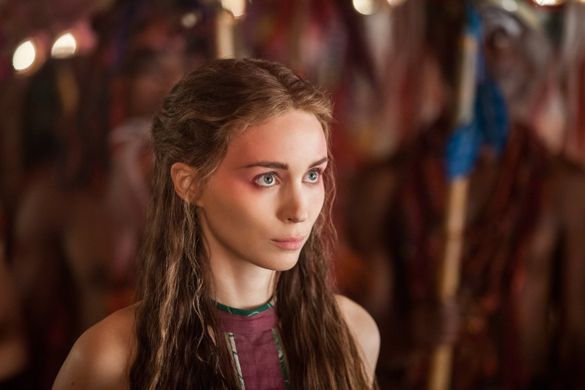
Despite most of these portrayals occurring many years ago, it is still present in the 21st century. One recent incident was the “controversial casting of white actor Rooney Mara as Tiger Lily” (Child 2015) in the 2015 film Pan (Joe Wright, 2015). Whilst these roles could have been taken by Native American actors, they are instead given to white actors, disallowing Indian actors from even representing themselves on screen let alone representing themselves accurately. However, The Revenant did not participate in any white-washing or cultural appropriation; all Native American characters were played by Native Americans. This meant that their culture or history was not taken for granted in the film, and they could portray their characters as respectfully and realistically as they could.
In conclusion, great efforts went into making the film The Revenant historically accurate in its portrayal of Native Americans, which it did. Part of this success is down to director Iñárritu and his diligence into ensuring that the language of the Indians was recreated faithfully, not butchered into something offensive as it has been done in past films that show Native Americans barely able to communicate. It is also due to the fact that great care was also put in by the production team to ensure that their culture was portrayed accurately. The visual aspects, such as the routine of the medicine man which showed an accurate example of an important tradition, along with their clothing and the music and sounds all tied together important aspects of life as a Native American in the 1800s. By linking this all with their spiritual beliefs and dependence on nature, the filmmaker’s stance of showing the destruction of the environment shows a new perspective of Native Americans in film; as defenders of their lands, lifestyles, and animals, whilst also trying to protect the people they loved. By presenting the white settlers and the actions they took more accurately, which was to murder and destroy the people and the land, the viewer is more understanding that the Indians were merely trying to protect their livelihoods. After decades of presenting Native Americans as savages, the question to be asked: “is not so much whether or not White culture has sought to represent Indigenous people accurately, as what aspect of itself it has understood them to represent.” (Cameron et al, 1996 p.46)

BIBLIOGRAPHY:
Adams, J. L., 1994. John Luther Adams: Earth and The Great Weather [download]. Available from: iTunes [Accessed: 26 December 2018]
Child, B., 2015. Joe Wright defends casting of Rooney Mara as Tiger Lily in Peter Pan film. The Guardian [online], 25 September 2015. Available from: https://www.theguardian.com/film/2015/sep/25/joe-wright-rooney-mara-tiger-lily-peter-pan [Accessed 20 December 2018]
Dances with Wolves, 1990 [Film, Streamed] Directed by Kevin Costner. USA: Tig Productions
Gajanan, M., 2016. Woman whose voice was used in The Revenant got no screen credit or money. The Guardian [online], 14 March 2016. Available from: https://www.theguardian.com/film/2016/mar/14/the-revenant-womans-voice-used-without-screen-credit [Accessed 20 December 2018]
Hearne, J., 2005. The “Ache for Home”: Assimilation and Separatism in Anthony Mann’s Devils Doorway. In: Rollins, P., and O’Connor, J., Hollywood’s West: The American Frontier in Film, Television and History. Kentucky: The University Press of Kentucky. 132-135
Lewis, D., 1995. Native Americans and the Environment: A Survey of Twentieth-Century Issues, American Indian Quarterly, Vol. 19 No. 3 [online]. Available from: https://www.jstor.org/stable/1185599?seq=1#page_scan_tab_contents [Accessed 22 December 2018]
Maltby, R., 1996. A Better Sense of History: John Ford and the Indians. In: Cameron, I., and Pye, D., The Movie Book of the Western. London: Studio Vista. 43-46
Newman, K., 1990. Wild West Movies. London: Bloomsbury Publishing Limited
Nolan, B., 2016. IU linguists provide Arikara and Pawnee dialogue for Oscar-nominated film ‘The Revenant’. Indiana University Bloomington [online], 3 Feb 2016. Available from:http://archive.inside.indiana.edu/editors-picks/arts-humanities/2016-02-03-the-revenant.shtml [Accessed 22 December 2018]
Oscars, 2008. Marlon Brando’s Oscar win for “The Godfather” [video, online]. YouTube. Available from: https://www.youtube.com/watch?v=2QUacU0I4yU [Accessed 22 December 2018]
Pan, 2015. [Film, Streamed] Directed by Joe Wright. USA: Berlanti Productions
Pearson, R., 1998. The Twelve Custers, or, Video History. In: Buscombe, E., and Pearson, R., Back in the Saddle Again: New Essays on the Western. London: British Film Institute. 201-209
Peter Pan, 1953. [Film, DVD] Directed by Clyde Geronimi. USA: Walt Disney Productions
Pettersson, E., 2017. Native Americans on Screen in 1939 and 2015: A Postcolonial Study on the Portrayal of the Indigenous People of America in Films and How to Adapt it into the EFL Classroom [online]. Thesis (Bachelors). Linnaeus University.
ResearchGate, 2017. Environment and Emotion in The Revenant: A Cognitive Approach [online]. Austria: University of Klagenfurt. Available from: https://www.researchgate.net/profile/Marijana_Mikic2/publication/318791892_Environment_and_Emotion_in_The_Revenant_A_Cognitive_Approach/links/597f21cea6fdcc1a9acd6e7a/Environment-and-Emotion-in-The-Revenant-A-Cognitive-Approach.pdf [Accessed 20 December 2018]
Sitting Bull, 1954. [Film, Streamed] Directed by Sidney Salkow. Mexico: United Artists
The Revenant, 2015. [Film, DVD] Directed by Alejandro González Iñárritu. USA: 20th Century Fox.
The Wild Bunch, 1969. [Film, Streamed] Directed by Sam Peckinpah. Mexico: Warner Bros. Seven Arts
20th Century Fox, 2015. A World Unseen [video, online]. YouTube. Available from: https://www.youtube.com/watch?v=pJfTfsXFbLk. [Accessed 22 December 2018]


 The Revenant - Critical Analysis